
1. Did you know that Saint Nicholas (a.k.a., Santa Claus) was born ca. 270 CE in Patara, a city in Lycia (southwestern Turkey/Anatolia)? From a wealthy family of Greek heritage (which had likely lived in Lycia for generations), St. Nicholas was famous for being pious, kind (especially to women & children), generous with his wealth, & fond of giving secret gifts — traits that contributed to his later transformation into our modern ‘Santa Claus’. In time, he became the Bishop of Myra, a port town in southwestern Turkey/Anatolia. When he died, his tomb became a pilgrimage site. In 1087, after the Muslim Seljuk Turks had taken control of Anatolia (including Myra), merchants from the south Italian coastal town of Bari quietly ‘transported’ St. Nicholas’s bones, as relics, from Myra to Bari. (At the time, the theft by Europeans of religious relics throughout the broader Mediterranean region was called furta sacra, ‘holy theft.’ Allegedly, furta sacra stemmed from a desire to ‘protect’ such relics, but it is also worth noting that any town possessing renowned relics became a pilgrimage site, so benefitted economically). Once St. Nicholas’s bones were re-interred at Bari, he became known as ‘St. Nicholas of Bari.’ Notably (and unsurprisingly, given southwestern Anatolia’s extensive contact with the Near East), early depictions of St. Nicholas consistently make him dark-skinned. His portrayals only become ‘paler’ in later European art. Thus, Saint Nicholas, who in time became ‘Santa Claus,’ was very likely brown-skinned (Handwerk 2018; Curtis 2004)!

Left: Saint Nicholas of Bari. Tempera on panel. Painted in Italy by Pietro di Giovanni d’Ambrogio in the mid-1430s CE. Courtesy of The Metropolitan Museum of Art, NY; The Robert Lehman Collection (1975.1.28B). Public Domain
Right: Saint Nicholas. A Russian Icon, courtesy of the Kizhi Monastery, Karelia. Painted in the early 18th c. (1700s) CE. Public Domain.
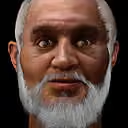
Reconstructed face of St. Nicholas, based upon his possible remains at Bari, Italy (from Curtis 2004).
Curtis, P. December 12, 2004. “Researchers Find the Real Face of Father Christmas”. The Guardian.com https://www.theguardian.com/education/2004/dec/13/highereducation.uk#:~:text=The%20real%20Saint%20Nicholas%20is,for%204th%20century%20religious%20leaders
Handwerk, B. December 25, 2018. “From Saint Nicholas to Santa Claus: The Surprising Origins of Kris Kringle”. National Geographic.com https://www.nationalgeographic.com/history/article/131219-santa-claus-origin-history-christmas-facts-st-nicholas#:~:text=Much%20of%20her%20work%20is,60%2Dyear%2Dold%20man

